Running a Household
Kitchen Storage Decides What A Family Eats
What a household cooks is shaped less by preference than by which ingredients and equipment are reachable, because friction at the point of cooking changes the decision.

Families eat what is easy to reach at the hour they are cooking. The arrangement of a kitchen therefore has more influence on the weekly menu than most people would credit.
Cooking decisions are made under time pressure
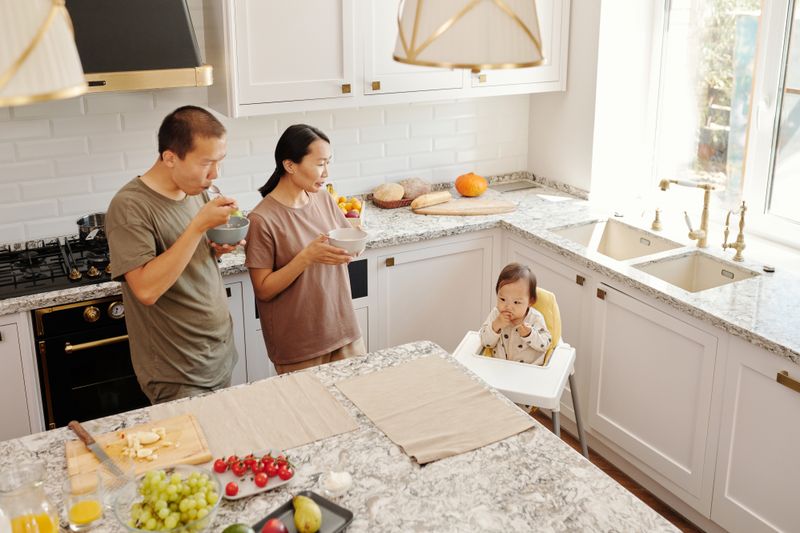
The evening meal is usually decided and started in a narrow window, often with children present and other tasks in progress. It is not a considered choice.
Under those conditions, small obstacles are decisive. An ingredient behind two other things, or a pan on a high shelf, is enough to change what gets cooked.
This is why the same household can own the ingredients for a varied menu and cook the same four meals. The other options exist but are marginally harder to start.
Reachability beats capacity
Kitchen advice tends to focus on how much can be stored. What matters for daily cooking is how much can be retrieved in one movement without moving something else.
The most-used items belong at waist height and at the front, even if that wastes space. Deep low cupboards are effectively archives whatever is nominally kept in them.
A useful test is which items have been moved in the last month. Anything untouched can be relegated, and the space it held given to something used daily.
The staples that need to be visible
A household that keeps its basic ingredients visible cooks from them. The same ingredients in an opaque cupboard behind the party glasses are effectively absent.
This applies particularly to the things that turn a meal into a different meal: spices, tinned pulses, stock, oils. They are cheap and small and easily buried.
Where storage is genuinely tight, moving rarely used equipment out of the kitchen entirely is usually the change that releases the most useful space.
The fridge is a queue with a hidden back
Food waste in family homes concentrates in the back of the fridge, where items are placed and not seen again. That is a storage failure rather than a planning one.
A designated shelf or box for things that need using this week converts an invisible problem into a visible one, and it is checked before anything new is bought.
Deep fridges and full ones both make this worse, which is why a fridge that is slightly emptier often produces less waste than one packed efficiently.
Children in the kitchen change the layout
Once children can get their own breakfast or a drink, a low shelf they can reach removes a recurring adult task several times a day.
The same principle applies to plates, cups and snacks. Anything a child can reach is something an adult stops being interrupted for.
It also puts more of the household work within reach of the people who generate it, which is a longer-term gain than the immediate convenience suggests.
Questions readers ask
Why did our bills rise more than expected?
Usually because the house went from empty during the day to occupied, rather than because of the extra person. Occupancy drives heating and lighting more than headcount does.
Is there any help with energy costs?
Schemes exist in many countries and differ completely between them, and eligibility is often wider than people assume. Check what applies where you live rather than assuming you do not qualify.