Parent Wellbeing
Exercise Has To Fit The Gaps Not The Plan
Parents abandon exercise because the standard model requires uninterrupted blocks at fixed times, and the versions that survive are the ones attached to something already happening.

Most exercise advice assumes a predictable hour. Parents do not reliably have one, which is why plans that were sustainable before children collapse within a few weeks.
The gap is scheduling, not motivation
A gym session requires travel, changing, the session and the return. The total is around two hours, and that block has to be uninterrupted and arranged with another adult.
Two hours is available on some days and not others, and which days is often not known until the day itself. Anything requiring advance certainty fails against that.
This is why parents commonly conclude they have lost the discipline they used to have. The constraint changed rather than the person.
Attaching activity to something already happening
The versions that survive are attached to fixed points that already exist: walking the school run, running from a child's training session, cycling a commute.
These work because they do not require an additional slot, and because the fixed point is already defended. If the school run happens, the walk happens.
They are usually less efficient than a proper session and vastly more consistent, which over a year is the more useful property.
Shorter and more frequent beats long and rare
A twenty-minute session that can be done at home requires no travel, no childcare and no negotiation. Its main advantage is that it survives a disrupted week.
Consistency matters more than intensity for general health, and short sessions accumulate. That is the basis for most public guidance, which is expressed in weekly totals rather than session lengths.
Anyone returning to exercise after a long gap, after a pregnancy, or with an existing condition should take the specifics from a GP or a physiotherapist rather than from general reading.
Doing it with the children present
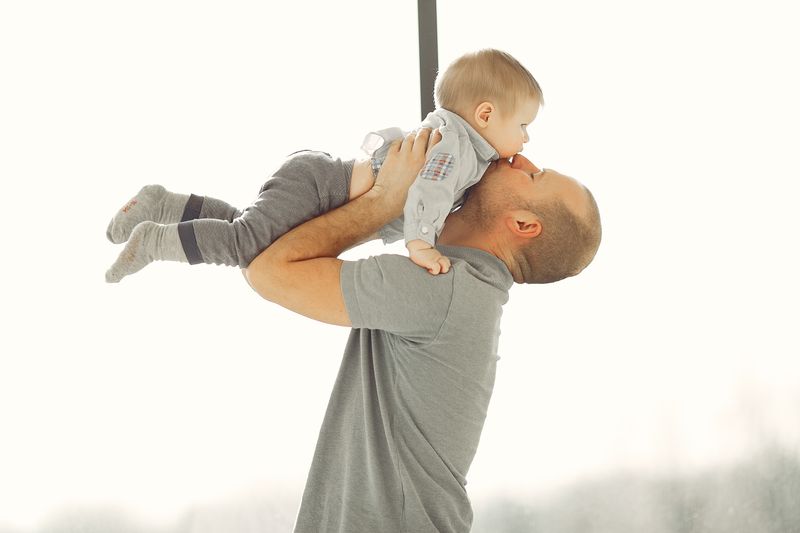
Some activity works with children involved: swimming, cycling, walking, playing. It is not a substitute for training but it is not nothing, and it removes the childcare requirement entirely.
Small children also add resistance in the literal sense. Carrying a toddler up a hill is genuine physical work, whatever it lacks in structure.
The limitation is that it proceeds at the child's pace and stops when they have had enough, which makes it unreliable as the only form of activity.
Team sport and the commitment problem
Fixtures happen at set times regardless of a family's week, which makes club sport the hardest form to sustain and the one most often given up first.
Where it is kept, it is usually because the household treats it as a fixed commitment for one adult, with an equivalent held by the other.
Making that explicit and reciprocal is what allows it to survive, because otherwise it is renegotiated every week against whatever else has appeared in the calendar.
Questions readers ask
My friends without children have drifted away. Is that normal?
Extremely, and it is usually about diverging routines rather than about anyone caring less. A low-effort recurring contact is often enough to keep the door open until schedules realign.
I do not have the energy for this. Where do I start?
One person, one recurring low-effort arrangement. Attempting to rebuild a whole social life at once is what makes it feel impossible.